Quick Answer: Yes. Teeth naturally drift back toward their old positions after braces or clear aligners, so a retainer is what keeps your result in place. Most people wear it full-time at first, then switch to nightly wear for the long term, and many dentists now recommend some form of retention for life.
You spent months, maybe years, straightening your teeth. Then the braces come off or you snap in your final aligner, and someone hands you a retainer. It’s fair to ask whether a retainer after braces is truly necessary, or just one more thing to lose in a residence dining hall. At UCC Dental, inside Western University’s University Community Centre in London, Ontario, we hear this question every week. The honest answer is that the retainer is what protects the investment you already made.
Why You Need a Retainer After Braces or Aligners
Teeth are not set in concrete. Instead, each tooth sits in bone and is held there by a ligament and gum fibres that stretch and remodel during treatment. Once active treatment stops, those tissues still “remember” where the teeth used to be.
Consequently, teeth tend to drift back. A 2017 review in the Australian Dental Journal explains that teeth move back toward the original bite because of periodontal, gingival, occlusal and growth-related factors. In addition, the authors note that teeth also shift with normal age changes, even in people who never had braces.
That second point surprises many patients. Your teeth keep moving slowly throughout adulthood. As a result, a straight smile at 20 can become a slightly crowded smile at 35 without any retention at all.
Is relapse really that common?
It is common enough that clinicians plan for it from day one. A 2023 Cochrane systematic review states plainly that without a retention phase, teeth tend to relapse to their initial position. Furthermore, the same Australian review points out that orthodontics cannot predict which patients will stay stable and which will relapse. Since nobody can tell in advance, wearing a retainer is the safest choice for everyone.
How Long Should You Wear a Retainer?
Short answer: longer than most people expect. Specifically, the first few months after treatment are the highest-risk period, because the bone and gum fibres around your teeth are still reorganizing.
A typical pattern looks like this, although your dentist will tailor it to your case:
- The first several months: near full-time wear, removed only to eat, drink anything other than water, and brush.
- After that: nightly wear, usually while you sleep.
- Long term: continued night wear, sometimes reduced to a few nights a week if your teeth stay stable.
However, “reduced” doesn’t mean “finished.” Many dentists now treat retention as an ongoing habit, much like brushing. If your retainer suddenly feels tight after a few skipped nights, that tightness is a warning. It means your teeth have already started to move.
What if I stopped wearing mine years ago?
Don’t force an old retainer onto teeth that have shifted. Instead, book an assessment. Minor movement can sometimes be managed with a new retainer, while larger changes may need a short course of clear aligners first.
Types of Retainers After Braces and Aligners
Retainers come in two broad families: fixed and removable. The Cochrane review notes that removable retainers can be worn full-time or part-time, and that retainers vary in shape, material and how they’re made.
Removable clear retainers
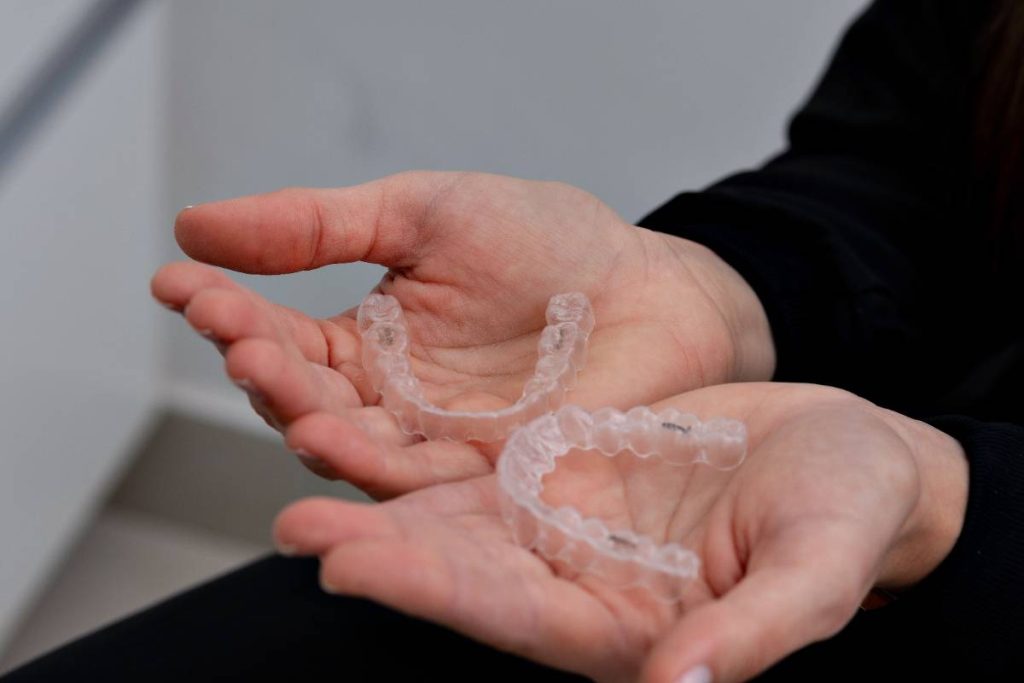
These look much like an aligner tray. They’re nearly invisible, comfortable, and easy to slip into a backpack between classes. On the other hand, they depend entirely on you remembering to wear them.
Removable wire retainers
Traditional wire-and-acrylic retainers are durable and adjustable. Additionally, they let your upper and lower teeth meet naturally when you bite, which some patients prefer.
Fixed (bonded) retainers
A thin wire bonded behind the front teeth works around the clock. Therefore, it removes the “did I forget?” problem. Nevertheless, it requires careful flossing, since plaque collects easily along the wire. Regular cleanings matter even more with a fixed retainer.
You can read more about the options we provide on our retainers page.
Caring for Your Retainer Between Classes
A retainer only works if it fits and stays clean. Here are habits that genuinely help busy students and staff:
- Rinse removable retainers in cool water; hot water can warp plastic.
- Brush them gently with a soft brush and mild, unscented soap rather than abrasive toothpaste.
- Always store them in a case, never in a napkin on a cafeteria tray.
- Keep them away from pets, who love chewing them.
Also, bring your retainer to every checkup. The Canadian Dental Association recommends regular dental visits so problems are caught early, and that includes checking whether your retainer still fits properly.
Getting a Retainer After Braces at UCC Dental
You don’t need to have finished treatment with us to get help. Whether you completed braces in your hometown or wrapped up clear aligners at our office, our team can assess your bite and recommend a retainer that suits your routine. We use digital X-rays and intraoral cameras to check tooth position and gum health, so you can see what we see.
Our location in Room 35 of the UCC Building also makes follow-ups simple. Students can drop in between lectures, and faculty and London residents enjoy short wait times and punctual appointments. We also accept the Canadian Dental Care Plan (CDCP).
Frequently Asked Questions
Do I need a retainer after clear aligners, too?
Yes. Teeth moved by aligners face the same biological pull back toward their old positions as teeth moved by braces. A retainer is just as important after either treatment.
Can I wear my last aligner as a retainer?
Sometimes, briefly. However, aligner plastic is thinner and wears out faster than retainer material. Ask your dentist before relying on it for more than a short time.
What should I do if my retainer breaks or gets lost?
Call your dentist promptly. Teeth can begin shifting within days, so replacing a retainer quickly reduces the chance you’ll need further correction.
Will wearing a retainer at night hurt?
It shouldn’t hurt. Mild pressure is normal if you’ve skipped a few nights. Persistent pain or a poor fit, on the other hand, means you should have it checked.
Protect Your Smile Starting This Week
Your straight teeth are worth keeping. If you’re unsure whether your retainer still fits, or you need one for the first time, our dental team at UCC Dental is right on campus. Contact us today to book a retainer check or consultation.
Sources & References
- Retention procedures for stabilising tooth position after treatment with orthodontic braces (Cochrane Database of Systematic Reviews, 2023)
- Retention and relapse in clinical practice (Australian Dental Journal, 2017)
- Canadian Dental Association: Regular Dental Checkups